

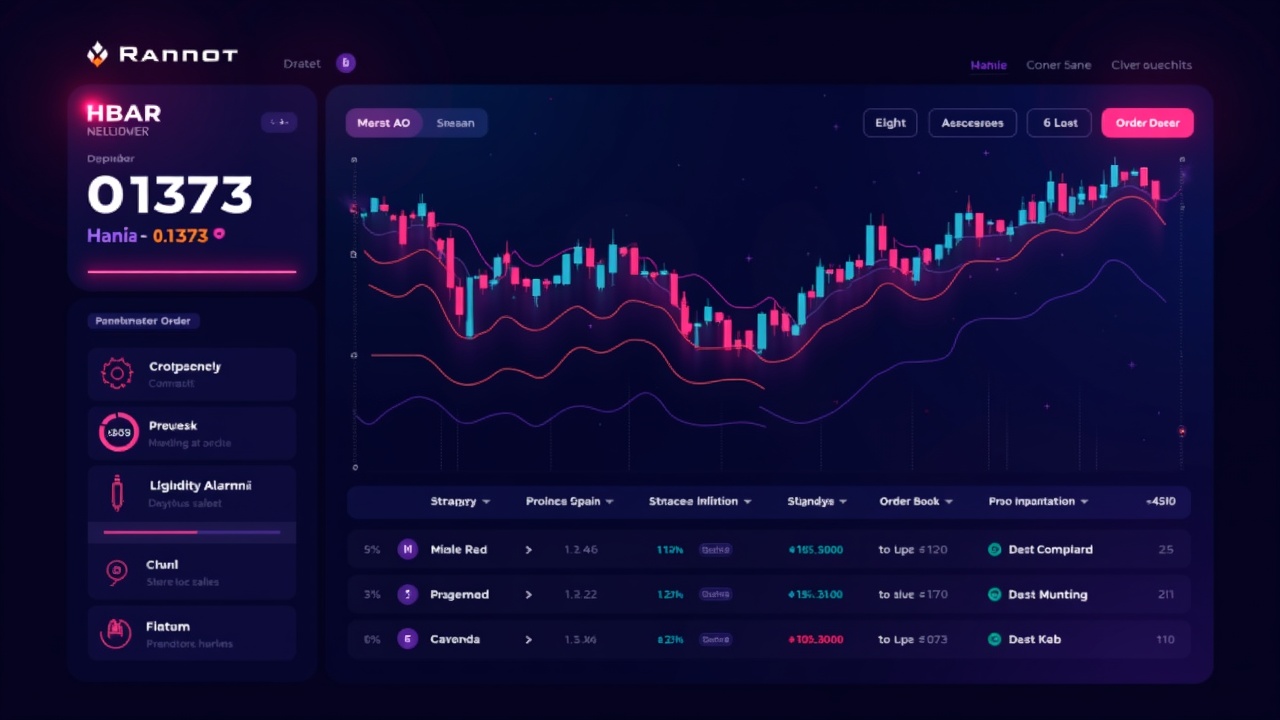
HBAR suffered a decisive breakdown to $0.136, a move that triggered liquidity signals and deepened the bearish tone in its market structure, according to data shared by specialized media. The sudden drop also included a brief trading halt with zero volume, amplifying doubts about market resilience and raising questions about the token’s ability to withstand heavy selling pressure. Meanwhile, a vesting schedule that continues increasing circulating supply through 2025 adds another challenge to price stability.
HBAR breakdown deepens uncertainty around liquidity and market structure
The drop cut through the key support at $0.145, shifting the trend from a neutral consolidation phase to a clearly bearish structure. The retracement reached an intraday low of $0.1382 —now viewed as the immediate critical support— while the former support at $0.1445 has flipped into resistance and the next significant upper barrier sits at $0.1486. Together, these levels define a fragile pivot zone where failed recovery attempts could easily reinforce the bearish outlook.
Between 14:12 and 14:14 UTC, trading paused with zero volume, a brief but notable interruption that hints at a momentary liquidity gap rather than a normal cooling-off period. At the same time, the vesting schedule —which gradually releases new tokens into circulation— suggests that the growing supply throughout 2025 could keep adding pressure during rebound attempts.
Market activity also reflects clear distribution patterns. Just before the breakdown, trading volume surged to 146.94 million tokens, 138% above the average, only to collapse to 9.76 million right before the drop. A V-shaped bounce from $0.1382, accompanied by another volume spike near the $0.1486 resistance, quickly faded, showing that buying interest remained too weak to counter sustained selling.
All current signals point to elevated risk: further depreciation, heightened volatility, and the possibility of deeper declines if liquidity continues to thin out. The weak reactions at key levels —combined with the inability to maintain strong volume— are reinforcing a growing sense of caution among traders.
The temporary trading halt also raises legitimate concerns about market infrastructure and may deter institutional participants if such disruptions continue during high-stress moments. Episodes like this can undermine confidence and delay risk-on flows, even when prices attempt technical recoveries.
Still, HBAR holds long-term fundamentals in terms of institutional adoption —including involvement from organizations such as Google, the White House, OpenAI, and DTCC, plus integrations with Google Cloud BigQuery. However, these positives are currently overshadowed by the immediate technical damage and liquidity challenges dominating market sentiment.
With the breakdown to $0.1373 and the loss of nearby supports, HBAR enters a high-risk phase. The way the $0.1382 support evolves —along with the market’s ability to absorb the increasing supply through 2025— will be critical for restoring confidence and preventing deeper structural weakness.