

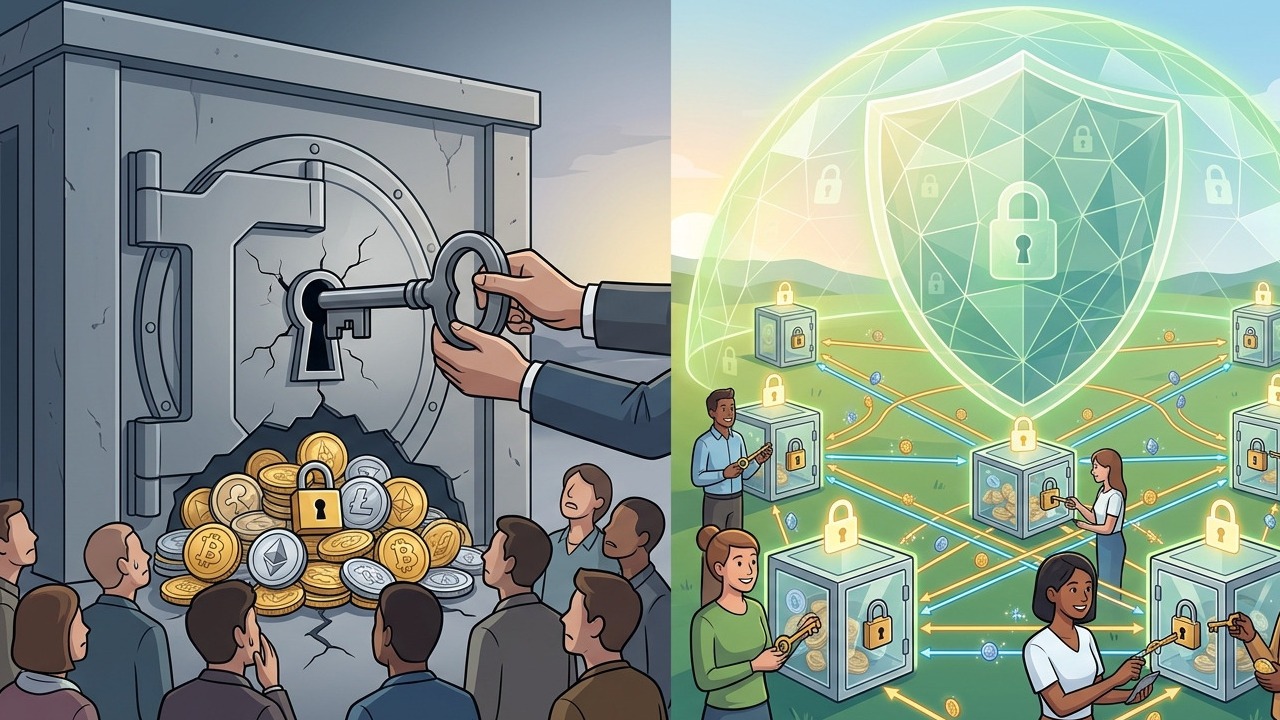
Anyone asking whether DEXs are safe is really asking a harder question: safe from what? Security in crypto depends on where trust sits. On decentralized exchanges, users keep custody and trades settle onchain, which the IMF says can mitigate counterparty risk and reduce dependence on opaque intermediaries. On centralized exchanges, convenience comes from handing keys, operations, and surveillance to a firm. That model can feel safer day to day, until concentration becomes the vulnerability. The 2025 Bybit theft, in which attackers gained control of an ether wallet and stole about $1.5 billion, was a reminder that custody concentrates blast radius.
Where DEX security is real
The best case for DEXs is straightforward. They remove the exchange itself as the main point of failure. Wharton researchers say DEXs offer transparent pricing plus simultaneous execution and settlement, while IMF analysis argues public blockchains reduce the need to trust institutions that may be opaque or error-prone. That is not a small advantage after years of exchange failures, freezes, and ownership disputes tied to custodial wallets. If assets stay in a self-custodied wallet until the transaction executes, the user is no longer underwriting a platform’s balance sheet, treasury practices, or commingling decisions. In security terms, that is architectural progress.
But DEX safety comes with a brutal condition: the user inherits much of the operational burden. Self-custody converts platform risk into personal responsibility. Investor.gov says that if self-custodied wallets are lost, stolen, damaged, or hacked, investors may permanently lose access to their assets. Wharton’s DEX paper adds another layer: smart contract bugs, public mempools, and blockchain design create risks such as re-entrancy exploits, front-running, and sandwich attacks. In other words, DEXs may reduce the chance that an exchange fails you, while increasing the chance that code, transaction ordering, or your own key management does. That trade-off is real for users.
Why CEXs still feel safer to many users
Phrased differently, centralized exchanges are not automatically less secure. For many beginners, they are safer in the narrow operational sense. Custodial platforms are easy and convenient to use, Reuters notes, and intermediaries in traditional-style markets provide custody, authentication, settlement, and regulatory compliance. Those services matter because most users are not prepared to manage seed phrases, contract approvals, phishing defenses, and cross-chain transfers without mistakes. Yet the protection is conditional. When the custodian is breached, insolvent, or unclear about asset ownership, convenience can quickly become exposure for customers. A safer interface does not eliminate the single point of failure beneath it.
So, are DEXs safe? Yes, but only if you define safety as minimizing dependence on custodians rather than minimizing user mistakes. DEXs are usually safer against exchange insolvency, asset commingling, and honey-pot hacks because users keep control until execution. CEXs are often safer against novice errors because intermediaries provide authentication, settlement support, and compliance functions that users underestimate. The uncomfortable truth is that crypto has not eliminated risk; it has redistributed it. For sophisticated users with strong wallet hygiene, DEXs can be safer. For newcomers, the safer venue may still be the one with guardrails, not the one with ideology.