

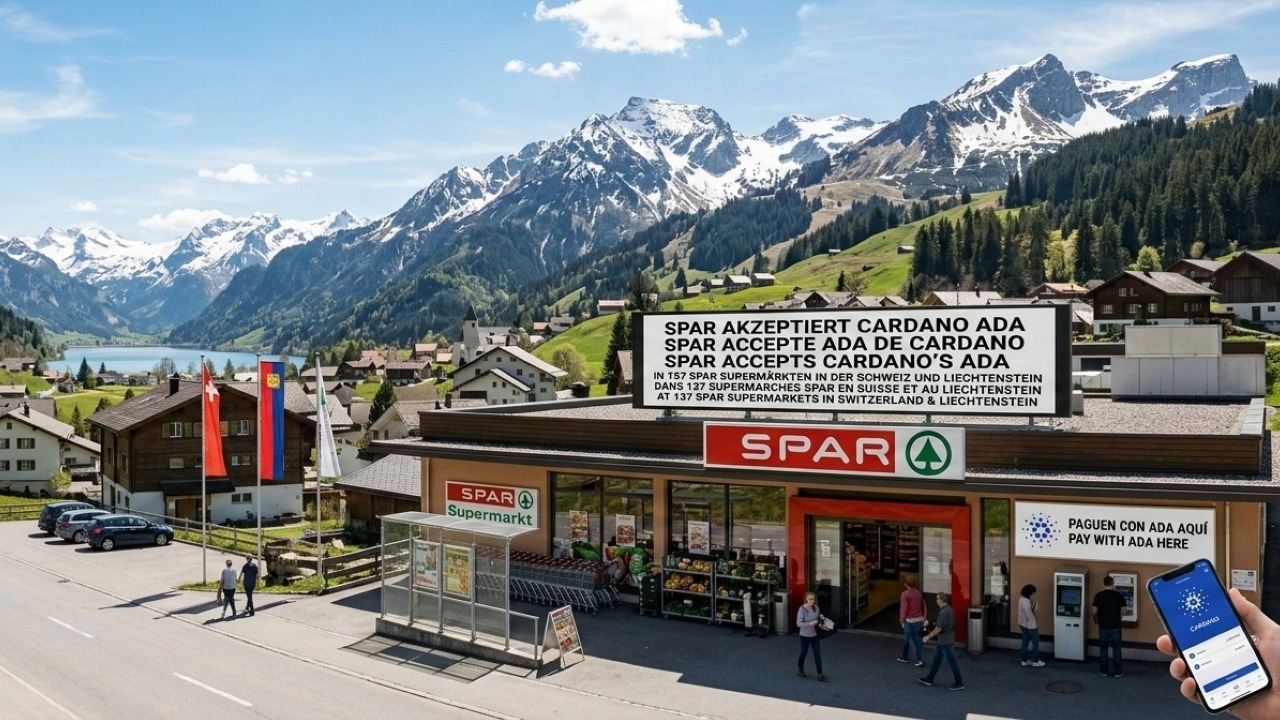
Cardano’s native token ADA is now live as a payment option at 137 SPAR supermarkets across Switzerland and Liechtenstein, according to the Cardano Foundation. The rollout positions ADA as a checkout rail, not just a traded asset, by plugging it into everyday retail payments.
The implementation runs on the Open Crypto Pay standard and a partnership with Swiss fintech DFX.swiss, using direct wallet-to-wallet transfers via QR code. Customers pay by scanning a QR code with an ADA wallet, triggering on-chain settlement without routing funds through a centralized exchange.
You can now pay with $ADA at 137 SPAR stores across Switzerland.
In partnership with @DFX_swiss and @BrickTowers, we are helping bring blockchain into everyday commerce through real-time, low-cost retail payments.
Read the full press release: https://t.co/gvYRHclp4F
— Cardano Foundation (@Cardano_CF) March 5, 2026
How the checkout flow is designed
The core promise is speed and cost efficiency. The Cardano Foundation and DFX.swiss say payments settle in real time and can cut merchant transaction fees by roughly two-thirds versus traditional card payments. That is the pitch to merchants: fewer intermediaries, faster settlement, and a simpler path from “approved” to “final.”
The architecture also puts custody and control with the payer. By keeping the transaction wallet-native under Open Crypto Pay, the system aims to reduce reliance on third-party payment processors while preserving self-custody at checkout. In effect, SPAR becomes a live testbed for whether blockchain payments can feel routine in a high-frequency retail environment.
Frederik Gregaard, CEO of the Cardano Foundation, framed the moment as a shift from experimentation to infrastructure. “We’re witnessing the beginning of a fundamental shift in how value moves through society,” he said. The broader message is that the tech should fade into the background, with the payment experience becoming as familiar as tapping a card.
What matters for adoption and market impact
So far, market reaction has been restrained. Reporting around the launch described ADA’s immediate price response as muted, reinforcing that utility only moves markets when usage becomes habitual. For this to matter beyond headlines, the rollout needs repeated consumer behavior and consistent merchant acceptance, not one-off curiosity payments.
From an operational standpoint, the real signal is whether usage becomes measurable and persistent. Traders will watch whether incremental on-chain spend turns into sustained flow, and whether liquidity and derivatives positioning amplify—or dampen—that translation into price. On the treasury side, any merchant or corporate entity accepting ADA still has to manage volatility and conversion workflows, even if the payment fee profile looks attractive.
The SPAR deployment also extends a pattern rather than appearing out of nowhere. It follows an August 2025 pilot that enabled crypto and stablecoin payments in about 100 stores, suggesting continuity in Swiss retail experimentation. The main risks remain straightforward: consumer habits are slow to change, merchant rollouts can stall after initial PR, and sustained demand is required for meaningful economic impact.